
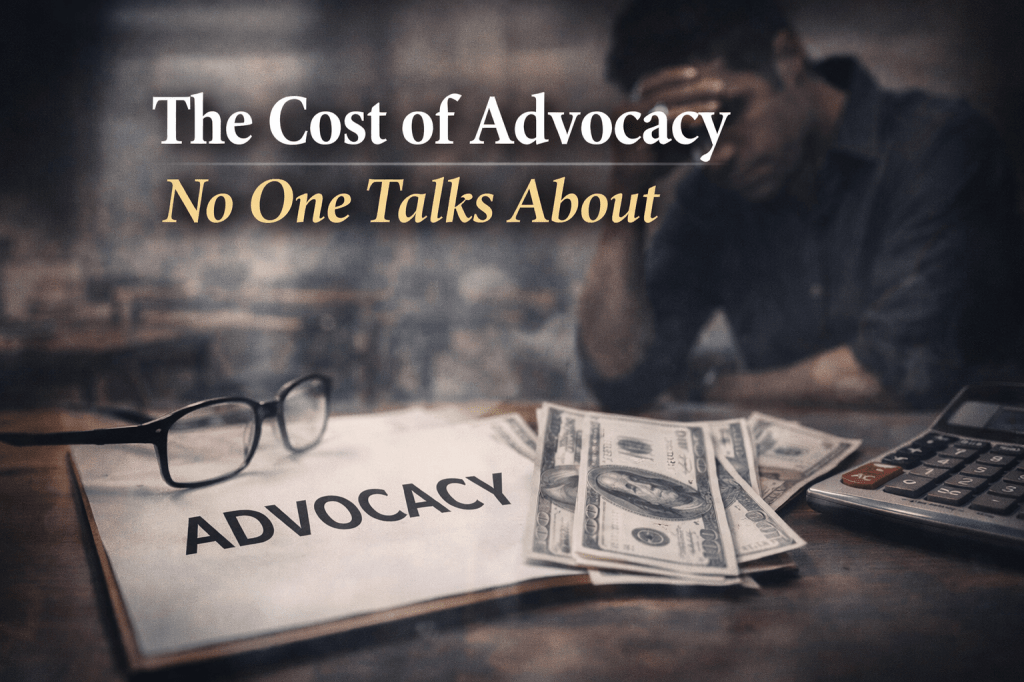
Advocacy is often framed as a moral obligation.
Stand up. Speak out. Fight back.
What is rarely discussed is what that fight actually costs.
Not in abstract terms.
In time. In money. In cognitive load. In stability.
Because advocacy is not just a mission.
It is a system — and most people enter it without understanding the demands of that system.
The Time Cost
Advocacy does not operate on a fixed schedule.
It expands.
What begins as a focused effort — a petition, a case, a campaign — quickly becomes:
- Research
- Documentation
- Communication
- Coordination
- Response cycles
Every new development creates additional obligations.
Every unanswered issue creates pressure to act.
Over time, advocacy begins to consume the same resource most people underestimate:
Attention.
And once attention is fragmented, everything else follows.
The Financial Reality
Most independent advocacy has no built-in funding model.
There is:
- No predictable revenue
- No institutional backing
- No compensation for time spent
But there are real costs:
- Filing fees
- Platform costs
- Travel
- Professional services
- Opportunity cost from lost income
The result is a structural imbalance.
Advocacy demands professional-level effort while operating on volunteer-level resources.
That gap is where many efforts begin to break down.
The Cognitive Load
Advocacy requires constant context switching.
You are:
- Tracking facts
- Managing timelines
- Responding to new information
- Anticipating opposition
- Making strategic decisions under pressure
This is not passive work.
It is sustained mental engagement at a high level.
Over time, that creates fatigue — not because the cause is weak, but because the load is continuous.
Most people do not fail because they stop caring.
They fail because they run out of capacity.
The Hidden Instability
As advocacy expands, it begins to affect other areas of life:
- Work performance
- Financial planning
- Personal relationships
- Health
This is rarely intentional.
It is the result of a system that has no natural boundaries.
Without structure, advocacy becomes reactive.
And reactive systems are inherently unstable.
The Expectation Gap
One of the most damaging assumptions in advocacy is that effort will produce proportional results.
It often does not.
Progress is uneven.
Resistance is persistent.
Outcomes are delayed or uncertain.
This creates an expectation gap:
High input.
Unclear output.
Without adjusting for that reality, frustration builds — not because the cause lacks merit, but because the system does not reward effort in predictable ways.
What This Means
Understanding the cost of advocacy is not about discouragement.
It is about clarity.
When people underestimate the structural demands, they:
- Overextend early
- Operate without systems
- Burn resources inefficiently
- Lose sustainability
Advocacy that lasts is not driven by intensity alone.
It is supported by structure, pacing, and strategic discipline.
Final Thought
The question is not whether a cause is worth fighting for.
The question is whether the fight is being approached in a way that can be sustained.
Because most advocacy does not fail due to lack of passion.
It fails because the cost was never fully understood.
If you are leading or navigating an advocacy effort and need clarity on structure, pacing, and long-term sustainability, I work with individuals and organizations operating in high-pressure environments.
 Mike Phillips Media
Leave a comment