
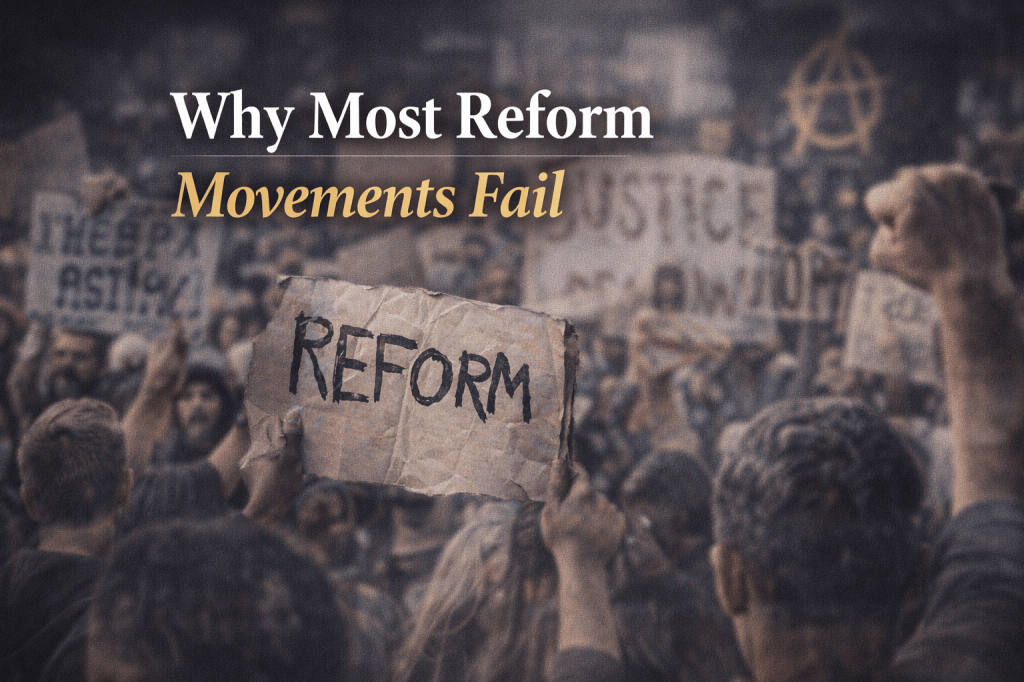
Reform movements rarely fail because the issue lacks merit.
They fail because the structure behind the effort cannot sustain the pressure required to produce change.
At the beginning, momentum is easy.
There is:
- Energy
- Attention
- Urgency
- A clear sense of injustice
But reform is not driven by energy.
It is driven by structure.
And most movements never build one.
The Illusion of Early Momentum
In the early phase, reform efforts often appear stronger than they are.
There is:
- Social amplification
- Rapid alignment around messaging
- Initial public support
- Short-term engagement spikes
This creates the impression of progress.
But attention is not infrastructure.
Momentum without structure creates a false signal — one that disappears as quickly as it formed.
No Operational Backbone
Most reform efforts begin as loose coalitions.
They lack:
- Defined leadership roles
- Decision-making processes
- Clear strategic priorities
- Internal coordination systems
Without an operational backbone, even well-intentioned groups fragment.
Work is duplicated.
Messages drift.
Execution becomes inconsistent.
And over time, the effort slows — not because people disengage, but because the system cannot coordinate itself.
No Sustainable Resource Model
Reform requires sustained input:
- Time
- Money
- Expertise
- Communication
But most movements operate without:
- Funding strategies
- Resource allocation plans
- Long-term support structures
They rely on volunteer energy and intermittent contributions.
That model works briefly.
It does not scale.
Eventually, the gap between effort required and resources available becomes too large to ignore.
Message Fragmentation
As movements grow, internal divergence increases.
Different participants begin to:
- Emphasize different priorities
- Use different language
- Advocate for different outcomes
Without message discipline, the external narrative becomes unclear.
To outsiders, the movement appears:
- Disorganized
- Inconsistent
- Unfocused
Clarity is replaced by noise.
And noise does not drive change.
Timeline Misalignment
One of the most consistent structural failures in reform movements is the mismatch between expectations and reality.
Participants expect:
- Rapid response
- Immediate accountability
- Visible progress
But institutional systems operate on longer timelines:
- Legal processes
- Legislative cycles
- Bureaucratic review
- Political negotiation
This creates friction.
When results do not materialize quickly, internal confidence drops.
Energy declines.
And participants begin to disengage.
Not because the issue is resolved.
Because the timeline was misunderstood.
The Absence of Strategic Escalation
Effective reform requires controlled escalation.
Not constant pressure.
Not reactive response.
Most movements either:
- Escalate too quickly and burn out
or - Fail to escalate strategically and lose relevance
Without a plan for when and how to increase pressure, efforts become inconsistent.
Institutions respond to structured pressure.
Not sporadic noise.
Internal Fracture
As stress increases, internal tension follows.
Common patterns include:
- Disagreements over direction
- Conflict over recognition or leadership
- Differing tolerance for risk
- Diverging priorities
Without structure, these tensions are not managed.
They fragment the movement.
And fragmentation weakens external influence.
What Actually Sustains Reform
Movements that endure share common characteristics:
- Clear leadership and decision-making
- Defined strategic priorities
- Consistent messaging
- Sustainable resource allocation
- Realistic timeline expectations
- Controlled escalation
In other words:
They operate like systems.
Not reactions.
Final Thought
Reform is not driven by how strongly people feel.
It is driven by how well the effort is structured over time.
Most movements do not fail because people stop caring.
They fail because the system supporting the effort was never built to last.
If you are leading or involved in a reform effort and seeing momentum stall, there are structural reasons for it. I work with individuals and organizations to bring clarity, coordination, and sustainability to high-pressure advocacy work.
 Mike Phillips Media
Leave a comment