
The skills that make reporters good at finding the truth turn out to be exactly the skills that make copy convert.
By Mike Phillips
There’s a version of this piece where I make the comparison sound novel. I’m not going to do that. It’s not novel. People have been observing the overlap between journalism and copywriting since at least the 1920s, when a lot of the people who invented modern advertising were former newspaper reporters who had been trained to write fast, write true, and write for someone who might stop reading at any moment.
What is underappreciated — still, in 2026, in a world where everyone has read a hundred articles about “content strategy” — is exactly which journalism skills transfer, and why. It’s not the obvious ones. It’s not speed, though speed helps. It’s not meeting deadlines, though that matters too.
It’s specificity. It’s the discipline of finding the most interesting true thing and saying it as directly as possible. And most marketing copy — most of it — fails precisely because it does the opposite.
Most marketing copy fails because it is written to avoid saying anything specific enough to be wrong.
The Problem With Safe Copy
Spend an afternoon reading the homepages of companies in any competitive category — broadband providers, law firms, SaaS platforms, financial services — and you will notice something: they all sound like the same company. They are “innovative.” They are “passionate about their clients.” They “deliver results.” They are committed to “excellence” and “service.”
This language is not the result of bad writers. It is the result of a specific institutional pressure: the need to say something that cannot be disputed. Nobody can argue with “we’re committed to excellence.” It is unfalsifiable. And because it is unfalsifiable, it means nothing. A reader processes it as noise and moves on.
Journalists, at their best, are trained to distrust unfalsifiable claims. When a source tells a reporter that a company is “committed to innovation,” the reporter asks: what does that mean, specifically? What did you do? What changed? What can I verify? The reporting process is, in large part, a process of converting vague claims into specific, checkable facts.
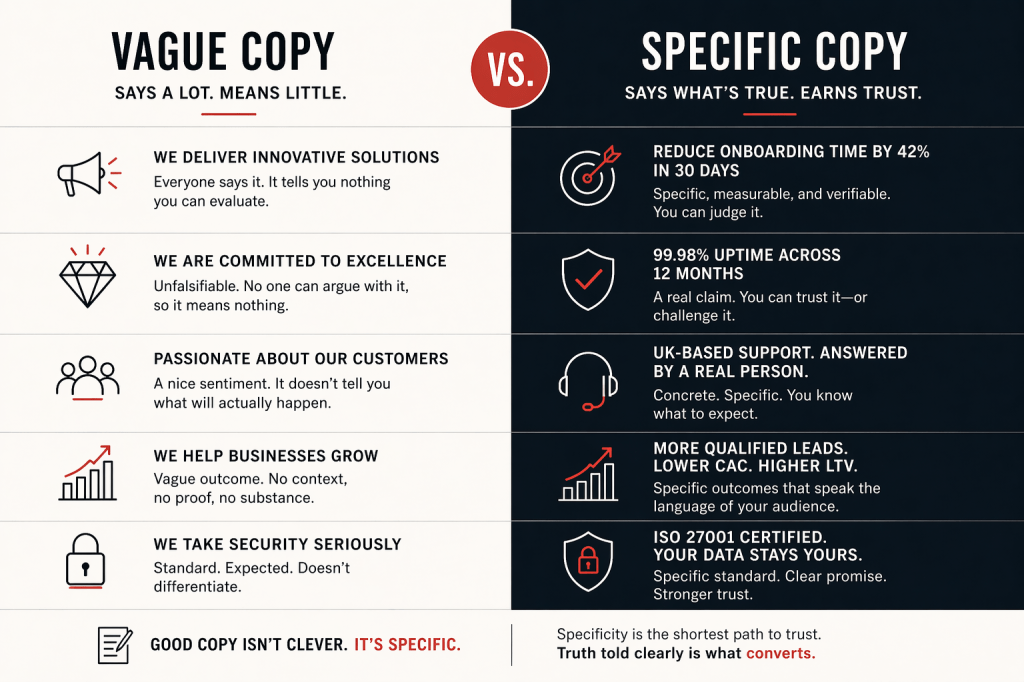
Good copy does exactly the same thing. It converts brand intent into specific, concrete language that a reader can actually evaluate. And the journalists who become copywriters — when they bring that instinct with them — tend to be unusually good at it.
Specificity Is the Mechanism
Here is a concrete example. These are two versions of copy for a fictional broadband provider:
VERSION A (AGENCY DEFAULT)
We’re committed to delivering fast, reliable broadband with outstanding customer service and transparent pricing for homes across the UK.
VERSION B (JOURNALIST INSTINCT)
The price you see today is the price you pay for the life of your contract. No mid-contract rises. No engineer who doesn’t show. Just broadband that works.
Version A is not technically wrong. Version B is the same product, described through specific, verifiable claims: price stability, appointment reliability, performance consistency. A reader can evaluate Version B. They can decide whether those things matter to them. They can trust it, or argue with it. Version A gives them nothing to hold onto.
The difference is not stylistic. It is structural. Version B is built from reported facts — the actual reasons customers switch providers, translated into copy that addresses those reasons directly. That translation requires knowing what the facts are, which requires research, which is what journalists do.
The best copy is reported copy. It starts with knowing the most important true thing about your audience and saying it back to them.
The Inverted Pyramid, Applied to a Homepage
One of the first things journalism students learn is the inverted pyramid: lead with the most important information, then support it, then add context. The idea is that a reader who stops at the first paragraph should still know the essential thing. Editors can cut from the bottom without losing the story.
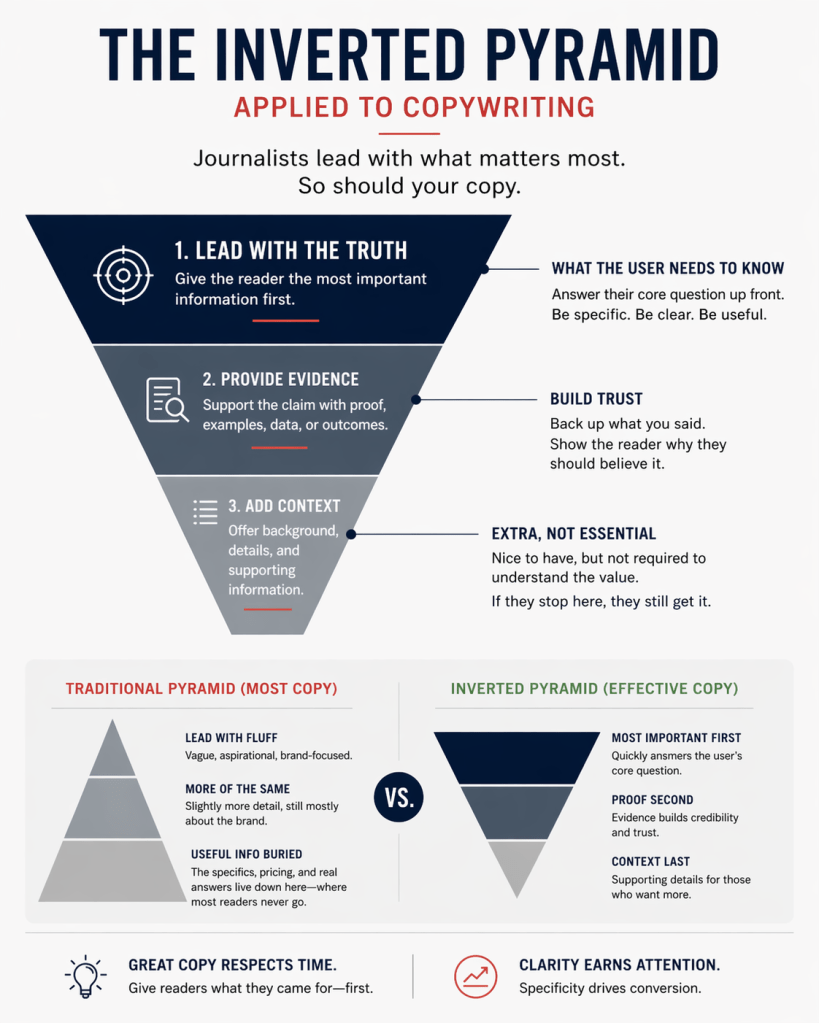
Most web copy is structured as a conventional pyramid: a vague, aspirational statement at the top, followed by slightly less vague claims, followed by the actual useful information buried in a third-tier feature description that most visitors never reach.
The reason for this is partly habit and partly a misunderstanding of what the reader needs. Copy is often written to impress the client, which creates an incentive to front-load the brand’s sense of its own identity rather than the user’s actual question. A user landing on a broadband homepage has one question: is this going to work for me, and at what cost? They are not there to be inspired.
An investigative reporter writing that homepage would answer the question in the first line. The rest of the copy would be evidence. That’s the inverted pyramid. It’s also, not coincidentally, how effective conversion copy tends to be structured.
Hearing What People Actually Say
Source interviews are another underrated transfer. Journalists spend a lot of time learning to listen for the phrase that is actually useful — the moment when a source stops giving you the official version and says the thing they actually mean. It is rarely the most polished sentence. It is usually the most specific one.
The equivalent in copywriting is customer language. The best copy tends to use the words that customers use to describe their own problems, not the words the brand uses to describe its solution. There is usually a significant gap between the two. “We deliver end-to-end connectivity solutions,” and “my internet drops every time someone else in the house gets on a video call,” are describing the same problem from opposite ends. The second one is what the customer says. The first is what the brand says back.
Reporters are trained to close that gap — to translate between institutional language and the language of the people the institution is supposed to serve. It is a craft skill, and it is exactly the skill that produces copy that resonates.
The Disclaimer Is Also Copy
One more thing, because it is specific to a kind of writing that marketing teams routinely abandon: the legal disclaimer.
Most brands treat disclaimer copy as a legal problem, not a writing problem. The result is language that is technically compliant and reads like a terms-of-service agreement. Users skip it entirely, which is fine until it becomes a trust issue — until someone reads the asterisk and feels deceived.
A journalist writing a disclaimer would ask: what does the reader actually need to know, and what is the clearest way to say it? The answer is usually shorter and more direct than what the legal team produces. “Introductory rate applies for 12 months; standard pricing applies thereafter” is clear. “The promotional rate referenced herein applies solely during the initial promotional period as defined in the applicable service agreement” is the same information, made unreadable.
The discipline of plain language — which journalism enforces constantly — is the discipline that makes legal copy readable. It is not in tension with compliance. It is in service of it.
The Point
I am not arguing that journalism training is sufficient for copywriting, or that agency experience is irrelevant. Brand strategy, campaign architecture, client management — these are real skills that take time to develop, and reporters who move into copy work have to learn them.
But the core craft — finding the most interesting true thing and saying it as directly as possible — is what journalists are trained to do, and it is what most marketing copy conspicuously lacks. The agency writers who are best at their jobs tend to be the ones who have internalized the same discipline, whether they learned it in a newsroom or somewhere else.
The brands that produce consistently good copy tend to be the ones that have learned to ask the same question a reporter would ask: what is the specific, verifiable, interesting thing we can say here? Not what do we want people to feel. What is actually true, and how do we say it clearly?
Good copy is not a creative mystery. It is a research and editing problem. Journalists have been solving it since before the web existed.


Leave a Reply