
How brands stopped making commercials and started licensing personalities — and what AI has to do with it
By Mike Phillips
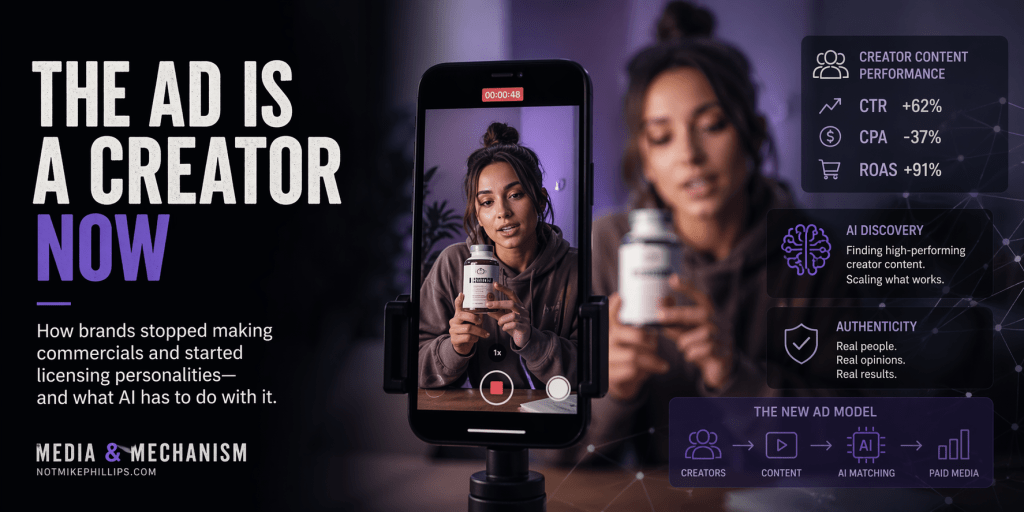
There’s a version of a social ad you’ve seen a thousand times and never quite registered as an ad. Someone holds up a supplement bottle in what looks like their bathroom. The lighting is bad in an intentional way. They say something like “okay, so I’ve been using this for three weeks, and I genuinely can’t believe—” and then they get cut off by a text overlay. It doesn’t look like advertising. It looks like your college roommate’s Instagram story.
That’s the point. And it’s now a multi-billion dollar industry.
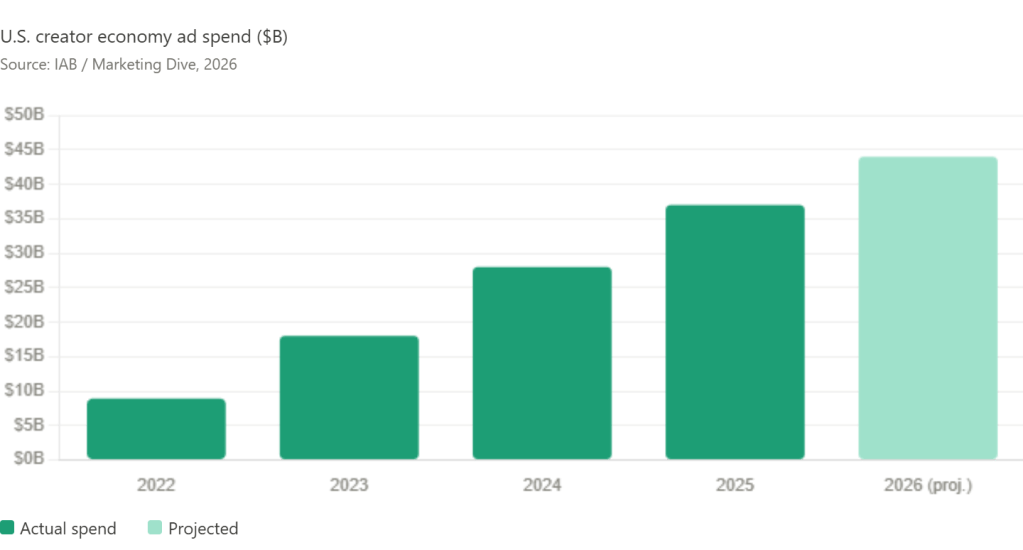
The creator economy — meaning the ecosystem of independent content producers who monetize their audiences through brand partnerships, affiliate deals, and licensing — generated $37 billion in brand spending last year and is on track to clear $44 billion in 2026, according to data from the Interactive Advertising Bureau. That’s not a niche supplement to traditional advertising anymore. The IAB now categorizes creator content as a “core media channel” — same tier as TV, display, and search. For context: search, the channel that built Google into the most valuable advertising business in human history, is currently losing market share to this.
What changed isn’t just the money. It’s the infrastructure.
The licensing model
For most of the creator economy’s history, the transaction was simple: brand pays creator to post, creator posts, brand hopes it works. One-off. Episodic. Hard to scale and harder to measure.
What’s emerging now — and what companies like Grapevine, Social Native, and a handful of others are building — is something closer to a content licensing market. Brands don’t just commission a creator post anymore. They identify organic content that’s already performing, license it, and run it as paid media. The creator becomes less like a spokesperson and more like a content vendor whose best work gets amplified through the ad stack.
Meta formalized this in late 2025 with updates to its Partnership Ads Hub, giving brands AI-powered tools to surface high-performing user-generated and affiliate content from Instagram creators and convert it directly into paid placements. The content existed already. The AI found it, matched it to campaign objectives, and fed it into the targeting machinery. The creator got paid. The brand got ads that didn’t look like ads.
This matters because of what the data says about why those ads work. Partnership ads — creator content run as paid media — deliver lower cost-per-acquisition and higher click-through rates than standard brand creative. The mechanism isn’t complicated: consumers trust people more than they trust companies. Audiences trust creators more than ads, and brands are leaning into that reality. An ad that looks like a person’s genuine recommendation activates a different part of the brain than an ad that announces itself as an ad.
The AI layer
Here’s where it gets structurally interesting for anyone who works in content.
AI is operating at two distinct points in this system, and they’re in tension with each other.
The first is on the production side. Brands and agencies are using AI to generate ad copy, variations, and even synthetic video at scale. Increasingly, brands are discovering that AI delivers the most value when it’s integrated across the entire content creation workflow — not as a standalone drafting tool but embedded in ideation, testing, and publishing. You brief the campaign once; the AI generates 40 variations for A/B testing; you review the best performers and push.
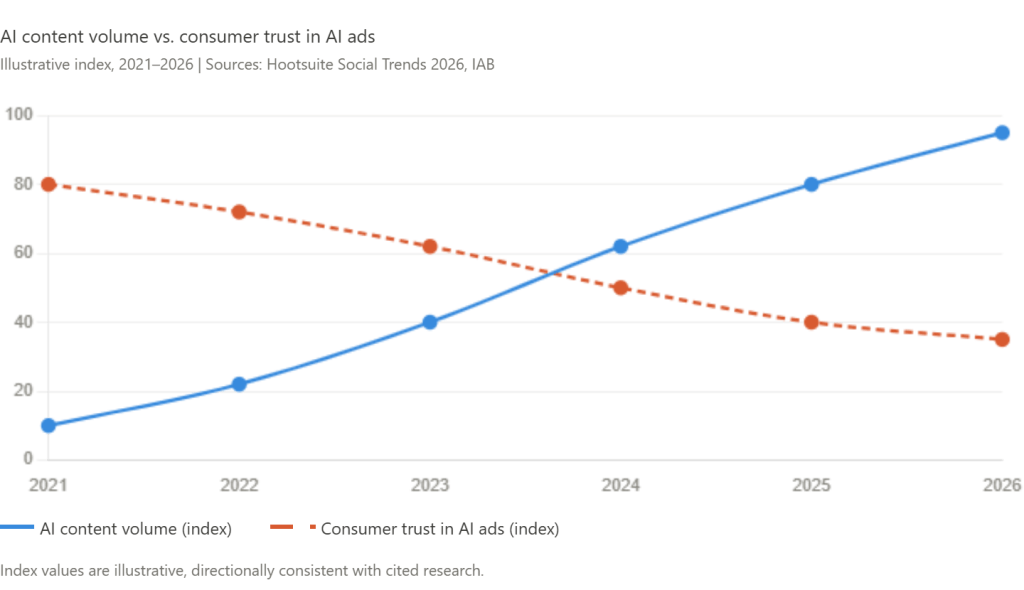
The second is on the consumer side. And this is the tension: nearly a third of consumers say they’re less likely to choose a brand that uses AI ads. The same audience that’s being targeted more efficiently by AI is also developing an allergy to AI-generated content that reads as AI-generated. What the industry calls “slop” — low-quality, high-volume, obviously machine-produced content — is actively driving consumers toward human creators as a counterweight.
More consumers are attracted to the human qualities of creators as feeds are flooded with low-quality, AI-generated content. The creator economy’s growth and the AI content explosion are happening simultaneously, and they are at least partly causally related. Creators are valuable precisely because they aren’t slop.
This creates a specific editorial problem that the market hasn’t fully solved yet. Brands want to use AI to produce content at scale. They also want that content to feel like it came from a real person. Those two things are not automatically compatible. The gap between them is filled, right now, by human editors — people who can take AI output and make it read as though a person with opinions and a personality actually wrote it.
What this means for the content stack
The practical implication is that the content production pipeline for social advertising now looks less like “hire a copywriter” and more like “hire a copywriter, a creator network, an AI platform, and an editor who can hold all of that together.”
Only 27% of creator content ties strongly to the brand. The fix, as the industry frames it, is structural — brands need creative platforms that align their messaging with creator authenticity without over-directing and killing the thing that makes creator content work in the first place. That’s a calibration problem. Calibration problems require judgment. Judgment is, for now, a human thing.
The brands that are winning at this aren’t the ones who figured out how to fully automate their content. They’re the ones who figured out how to use AI to do the parts of content production that are genuinely mechanical — variation generation, scheduling, performance analysis — while keeping humans in the loop for the parts that require knowing what sounds real.
That’s not a permanent arrangement, necessarily. But it’s the arrangement right now. And for anyone building a career in content, it’s useful to understand exactly which part of the stack you’re in.


Leave a Reply